There's something quietly satisfying about pointing a device at an object, pulling a trigger, and getting a temperature reading in half a second — no contact, no waiting, no fuss. Infrared thermometers have been around for decades in industrial settings, but they've quietly slipped into kitchens, first-aid kits, HVAC trucks, and automotive garages across the world. If you've ever held one and wondered how a gadget that never touches a surface knows exactly how hot it is, or if you're trying to figure out which model to actually buy, this is the guide for you.
What Is an Infrared Thermometer, Really?
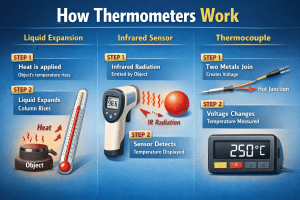
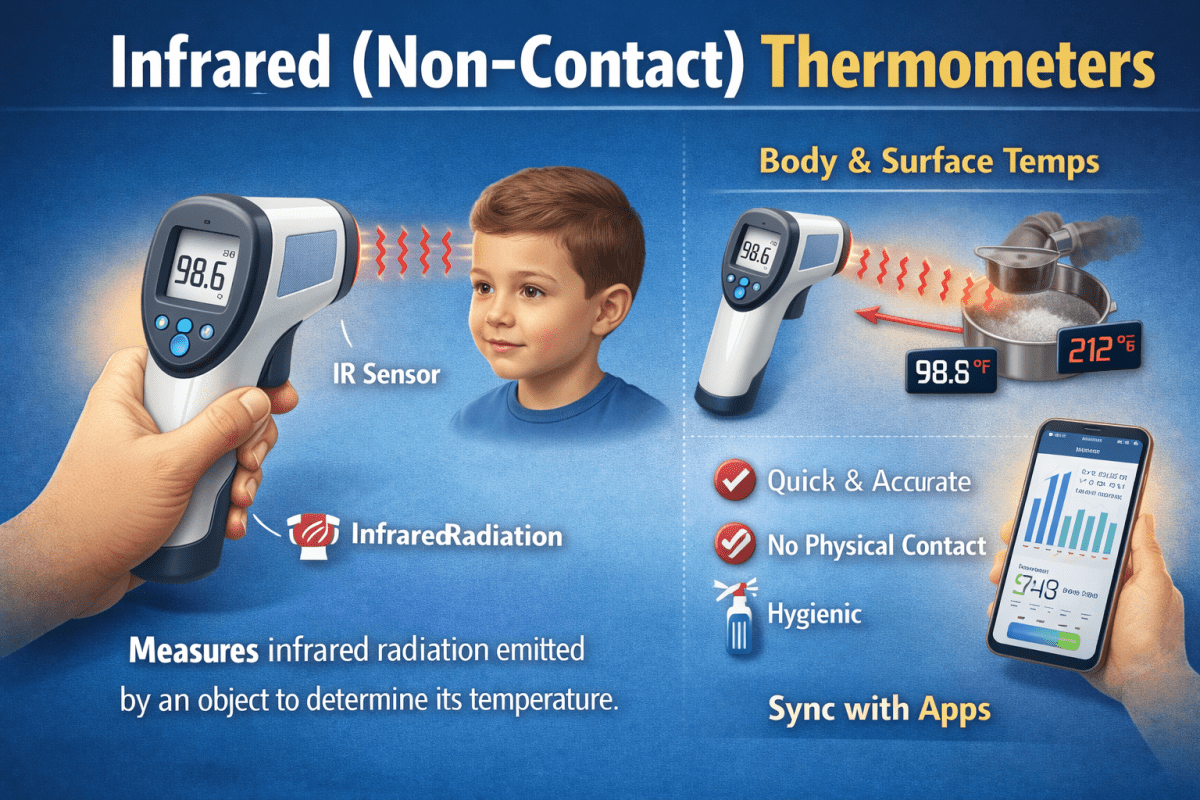
An infrared thermometer — also called a non-contact thermometer, IR thermometer, or laser thermometer — measures temperature by detecting the infrared radiation emitted by an object's surface. Every object above absolute zero (that's −273.15°C, the coldest anything can theoretically get) emits thermal radiation. The hotter the object, the more radiation it emits, and the shorter the wavelength of that radiation.
The device collects that radiation through a lens, focuses it onto a detector — usually a thermopile or pyroelectric sensor — and converts the signal into a temperature reading displayed on-screen. The whole process happens in milliseconds. It's physics working silently in your palm.
The laser you see on most consumer models? That's just a pointer. It helps you aim. It does not measure anything.
How the Measurement Actually Works — Emissivity and Why It Matters
Here's where most people's understanding of IR thermometers hits a wall: emissivity.
Emissivity is a measure of how efficiently a surface emits thermal radiation compared to a perfect "blackbody" emitter. A perfect blackbody has an emissivity of 1.0. Real-world objects range from about 0.1 (polished aluminum) to 0.98 (human skin, flat black paint, most organic materials).
This matters enormously. If you point your thermometer at a shiny metal surface and the device is set to an emissivity of 0.95, your reading could be off by 50°C or more. Most cheap consumer thermometers are factory-set to 0.95 and you cannot adjust them — which is fine for skin, food, and painted surfaces, but disastrous for bare metals.
Professional and industrial thermometers — like the Fluke 62 MAX+ (available at industrial suppliers such as Grainger, 100 Grainger Pkwy, Lake Forest, IL 60045, USA, or online at grainger.com) — allow you to adjust emissivity manually, which is why they cost more and why tradespeople actually rely on them.
The fix for shiny surfaces, when you can't adjust emissivity, is to apply a strip of electrical tape or matte paint to the area you're measuring, then point at that. The tape's emissivity is around 0.95, and you'll get a reliable reading.
Distance-to-Spot Ratio — The Spec Nobody Explains Properly
Every IR thermometer has a distance-to-spot ratio (D:S ratio), and it's the single most misunderstood number in the spec sheet.
A D:S ratio of 12:1 means that when you're 12 inches away, the device is averaging the temperature of a 1-inch diameter circle. At 24 inches, it's measuring a 2-inch circle. At 120 inches (10 feet), you're measuring a 10-inch circle.
Why does this matter? Because if your target is smaller than the measurement spot, you're getting an averaged reading that includes surrounding surfaces. A small electrical component surrounded by cooler air will give you a misleadingly low reading if your spot size is larger than the component.
For HVAC technicians inspecting duct work, a 12:1 ratio is usually fine. For someone checking a specific solder joint on a circuit board from a comfortable working distance, you'd want a 50:1 or even higher ratio — which puts you firmly in professional instrument territory. The FLIR TG165-X, sold at specialty electronics retailers like B&H Photo (420 Ninth Ave, New York, NY 10001, USA) and at bhphotovideo.com, offers a 24:1 ratio alongside its thermal imaging capability.
The Six Main Types of Infrared Thermometers
Not all IR thermometers are created equal. The category you need depends almost entirely on what you're measuring.
Consumer / Kitchen Models are the most common type people encounter first. Something like the Etekcity Lasergrip 1080 (widely available at Amazon, Target stores nationwide including Target locations at 1 Target Circle, Minneapolis, MN 55403, and at etekcity.com) sits in the $15–$40 range and handles food surface temperatures, checking whether a pan is hot enough before adding oil, scanning for drafts around window frames, or measuring a car engine bay after a drive. These are set-and-forget devices. Emissivity is fixed at 0.95 and the accuracy is typically ±1.5–2.0°C. For most home applications, that's more than sufficient.
Medical / Forehead Thermometers are a distinct subcategory. These are calibrated specifically for human body temperature ranges (roughly 35–42°C) and are designed to account for the lower emissivity of skin (around 0.98) and ambient temperature interference. The Braun No Touch + Forehead Thermometer (available at pharmacies including CVS locations, corporate headquarters at One CVS Drive, Woonsocket, RI 02895, USA, and online at braunhealthcare.com) can read within ±0.2°C — far more precise than a general-purpose model at that range, because the entire calibration is optimised for the narrow window of human body temperatures.
Industrial / HVAC Models are built for professional punishment. They handle extreme temperature ranges (often −50°C to 1,000°C or beyond), offer adjustable emissivity, have rubberised housings, and are often rated for water and dust ingress. The Fluke 62 MAX+ is the standard bearer here. Fluke Corporation is headquartered at 6920 Seaway Blvd, Everett, WA 98203, USA. Industrial models typically cost $80–$300 and are sold through electrical and HVAC supply chains like Grainger or Platt Electric Supply (platt.com, with branches across the western US).
Automotive Models focus on a temperature range suited to engines, brakes, tires, and exhaust systems. They often include Type K thermocouple inputs for contact measurements alongside the IR sensor, giving mechanics the flexibility to probe hard-to-reach areas. The INNOVA 3679 (available at AutoZone locations, corporate offices at 123 South Front Street, Memphis, TN 38103, USA) is a popular choice in this segment.
Thermal Imaging Thermometers blur the line between point-and-shoot IR guns and full thermal cameras. The FLIR TG165-X, for example, overlays a live thermal image on a standard visual image, letting you see the full temperature profile of a surface rather than just a single-point reading. These are invaluable for building inspectors looking for insulation gaps, water intrusion, or overheating electrical components. FLIR Systems (now part of Teledyne, 27700 SW Parkway Ave, Wilsonville, OR 97070, USA) leads this segment globally.
Fixed / Stationary IR Sensors are the industrial cousins you never see as a consumer. These are mounted permanently on production lines to monitor temperature in real time — on molten metal, food processing conveyors, pharmaceutical manufacturing. Companies like Raytek (a brand of Fluke Process Instruments, Raytek GmbH, Blankenburger Str. 135, 13127 Berlin, Germany) manufacture these for continuous process monitoring.
Where People Go Wrong — Common Mistakes With IR Thermometers
The technology is straightforward. The mistakes people make are predictable.
Measuring shiny surfaces without adjusting emissivity is the most common error, and we've covered that above. But the second most common mistake is measuring through glass or transparent plastics. IR thermometers cannot measure through glass. The reading you get is the surface temperature of the glass, not the temperature of whatever is behind it. This catches out anyone who tries to measure inside an oven through the door window, or the temperature of food inside a glass container.
The third mistake is ignoring ambient temperature acclimation. If you bring a cold thermometer in from outside on a winter day and immediately take a measurement, condensation and thermal lag will affect the reading. Most manufacturers recommend a 30-minute acclimatisation period before use in environments significantly different from storage conditions.
And the fourth mistake — particularly relevant to medical use — is measuring over clothing, hair, or at angles other than perpendicular. Most forehead thermometers require you to be within a specific distance range (typically 1–5 cm) and aimed directly at the center of the forehead. Measuring at 45° or from 15 cm away will give you a number, but it won't be a reliable one.
Infrared Thermometers in Medicine — A Post-Pandemic Reckoning
The COVID-19 pandemic pushed non-contact thermometers from hospital supply rooms onto airport security lines, school entrances, restaurant hostess stands, and living room drawers across the world. Global demand spiked so sharply in 2020 that manufacturers like Braun, Omron (global HQ: Omron Corporation, Shiokoji Horikawa, Shimogyo-ku, Kyoto 600-8530, Japan), and iHealth (iHealth Labs Inc., 2570 N. First Street, Suite 200, San Jose, CA 95131, USA) struggled to meet orders for months.
That period also revealed a significant consumer education gap. Many people were using general-purpose IR thermometers — the kind meant for cooking or HVAC work — to screen for fever, not realising those devices aren't calibrated for human body temperature and aren't validated for clinical use.
The FDA and equivalent regulatory bodies distinguish clearly between general-purpose IR thermometers and medical-grade clinical thermometers. If you're buying a thermometer for fever screening, look specifically for one that is FDA 510(k)-cleared or CE-marked for clinical use, with accuracy specifications at the human body temperature range. A device advertised for "cooking and body temperature" is not the same as one designed and validated for clinical fever detection.
Industrial and Trade Applications — Where These Devices Earn Their Price
Outside of kitchens and foreheads, IR thermometers do serious work.
In electrical maintenance, technicians use them to scan distribution panels, motor control centers, and transformer banks for hotspots that signal resistance buildup, loose connections, or impending failures — all without shutting down the circuit. The National Fire Protection Association (NFPA, 1 Batterymarch Park, Quincy, MA 02169, USA) includes infrared thermography in its guidelines for predictive maintenance programs under NFPA 70B.
In food processing and commercial kitchens, health codes in many jurisdictions require verifiable surface temperature checks on cooking equipment, refrigeration units, and food surfaces. A digital record of an IR measurement is now accepted as documentation in HACCP (Hazard Analysis Critical Control Points) programs.
In HVAC and building science, IR thermometers and their more sophisticated cousin, the thermal imaging camera, have become essential tools for energy audits. A technician from a company like Trane Technologies (800-E Beaty St, Davidson, NC 28036, USA) can scan an exterior wall in minutes and identify where insulation has settled, where air is infiltrating around window frames, or where a radiant barrier has failed.
Automotive technicians use IR guns to identify uneven brake rotor temperatures (indicating a dragging caliper), diagnose cooling system issues, and check whether catalytic converters are reaching operating temperature. The non-contact nature is particularly useful here — brake components run hot enough to cause contact burns, and having a 12:1 ratio device lets you measure from a safe distance.
Buying Guide — What to Actually Look For
When you strip away the marketing language, there are five specifications that actually determine whether an IR thermometer is right for your application.
Temperature range is first. Consumer models typically cover −50°C to 380°C, which handles almost everything domestic. If you're measuring exhaust temperatures, molten materials, or industrial kilns, you need a model with a range extending to 1,000°C or beyond.
D:S ratio determines whether you can get a useful reading from the distance you'll actually be working at. Calculate: target size × D:S ratio = minimum working distance. Or invert it: your working distance ÷ D:S ratio = your measurement spot size at that distance.
Accuracy and repeatability are not the same thing. Accuracy is how close to the true value a single reading is. Repeatability is how consistently you get the same reading on the same surface under the same conditions. For diagnostic work, repeatability often matters more than absolute accuracy — you're looking for anomalies and temperature differentials, not absolute values.
Adjustable emissivity determines whether the device is a professional tool or a consumer gadget. If you're only measuring food, skin, or painted surfaces, a fixed 0.95 setting is fine. If you're working with bare metals, shiny plastics, or ceramic surfaces, adjustable emissivity is non-negotiable.
Response time matters in fast-moving environments. Consumer devices typically respond in 500ms. Some professional instruments respond in under 150ms, which matters when you're scanning a moving conveyor belt or a rotating engine component.
The comparison table above captures the key specs across the most widely purchased models in each category as of 2025–2026. Use it as a starting framework, but always verify current pricing — IR thermometers have been subject to significant supply chain fluctuations since 2020.
Calibration, Maintenance, and When to Replace Your Thermometer
IR thermometers are passive optical devices — they don't have elements that wear in the way a mechanical thermocouple does. But they do drift, and they do fail.
The most common cause of drift is lens contamination. The small optical window on the front of the device can accumulate dust, grease (particularly in kitchen environments), and condensation. Cleaning it gently with a soft lens cloth restores accuracy in many cases. Do not use abrasive materials or solvents on the lens.
Professional instruments used in regulated environments — food processing, pharmaceuticals, clinical settings — should be calibrated annually against a NIST-traceable blackbody calibration source. Companies like Omega Engineering (800 Connecticut Ave, Norwalk, CT 06854, USA, omegaeng.com) offer calibration services alongside their sensor product lines.
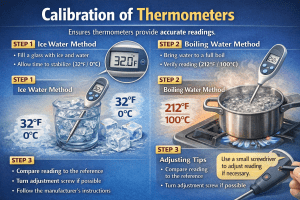
For consumer devices, a simple verification check is to measure a glass of ice water (which should read approximately 0°C) and a pot of boiling water (which should read approximately 100°C at sea level, adjusted for altitude). If your readings are consistently off by more than the device's stated accuracy, either adjust the emissivity setting or replace the unit.
Consumer IR thermometers in the $20–$50 range are often more economical to replace than to send for professional calibration. Professional instruments in the $100+ range are worth maintaining properly.
The Future of Non-Contact Temperature Measurement
Infrared thermometry is not standing still. The integration of thermal imaging arrays into increasingly small and affordable packages — driven partly by mobile phone components and partly by post-pandemic investment in contactless sensing — is pushing the capability curve fast.
Companies like Heimann Sensor (Grenzstraße 22, 01109 Dresden, Germany), FLIR (Teledyne FLIR, 27700 SW Parkway Ave, Wilsonville, OR 97070, USA), and Melexis (Rozendaalstraat 12, 8900 Ieper, Belgium) are developing thermopile arrays that fit in a smartphone camera module's form factor. The MLX90640 from Melexis, for instance, is a 32×24 pixel thermal array the size of a fingernail that costs under $20 in volume — it's already appearing in hobbyist projects, industrial sensors, and experimental building automation systems.
AI-enhanced image processing is also beginning to appear in higher-end thermal cameras, automatically detecting anomalies, flagging hotspots against stored baselines, and integrating temperature data with machine learning predictive maintenance models. At that end, you're no longer buying a thermometer — you're buying a diagnostic intelligence system.
For most of us, though, the $20 gun on the kitchen drawer or the Braun in the medicine cabinet will do exactly what we need it to do. Point, shoot, read. The physics is old. The applications keep getting newer.
Sources and manufacturer contact information cited throughout are accurate as of publication. Prices are approximate and subject to market variation. Clinical thermometers should always be used according to manufacturer instructions and are not a substitute for professional medical advice.